Timeless Hemingway Early YearsMiddle YearsLater Years

Ernest Hemingway FAQ: Section 1

Explore Books Collect FAQ Photos Videos Quotes Wiki Blog Links
 
Graded A+ by Education World Hemingway quotation Timeless Hemingway's Facebook Page
Hemingway First Editions

Hemingway First Editions

Judge a book by its cover
Learn to Identify First Editions


Hemingway On Stage

Hemingway On Stage

Brian Gordon Sinclair is the
foremost dramatic interpreter
of Hemingway in the world today
Book One of His Plays Now


Hemingway Quote Finder

Hemingway Quote Finder

Straight from the source
Find Hemingway Quotations


About        Advertise        Recommend        Press        Contact

Ernest Hemingway FAQ: Section 1

Question Can you provide a short Hemingway biography?

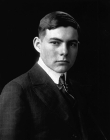
Answer Ernest Miller Hemingway was born on July 21, 1899 in Oak Park, Illinois to Dr. Clarence Edmonds Hemingway and Grace Hall Hemingway. The second of six children, Ernest enjoyed an adventurous boyhood, fishing and hunting with his father in the northern woods of Michigan. He attended Oak Park High School where he excelled in his classes, particularly English. He tried his hand at football and swimming, edited the school paper (the Trapeze), and contributed pieces to the school's literary magazine (the Tabula). After graduating high school, Ernest traveled to Kansas City and worked as a cub reporter for The Kansas City Star. In 1918, he began service as an ambulance driver for the Italian army. On July 8, he was wounded at Fossalta on the Italian Piave while delivering chocolates, cigarettes, and postcards to soldiers.

He married Elizabeth Hadley Richardson on September 3, 1921. The newlyweds soon entered the literary community of Paris, living off of Hadley's trust fund and Ernest's pay as a foreign correspondent for the Toronto Star. The 1920's were extremely productive writing years for Hemingway. Three Stories and Ten Poems was published in 1923, In Our Time in 1925. 1926 saw the publication of The Torrents of Spring and the widely successful novel, The Sun Also Rises. A collection of short stories titled Men Without Women followed in 1927. This year also signified the end of Hemingway's marriage to Hadley and his subsequent marriage to Pauline Pfeiffer on May 10, 1927. Ernest and Pauline would spend the majority of their years together at 907 Whitehead Street in Key West, Florida. On December 6, 1928, Hemingway was dealt a devastating emotional blow as his father, suffering from severe diabetes and concerned about his financial future, shot himself.

Hemingway continued to write producing what many critics still feel is the best novel ever written about World War I. A Farewell to Arms was published in 1929 and solidified Hemingway's reputation as one the greatest writers of his generation. The 1930's would see the publication of Hemingway's bible on bullfighting, Death in the Afternoon (1932), a recount of his African safari in Green Hills of Africa (1935) and two famous short stories, "The Snows of Kilimanjaro" (1936) and "The Short Happy Life of Francis Macomber" (1936).

In the late 1930's, Hemingway ventured to Spain to give his encouragement to the Loyalists fighting in the Spanish Civil War. His experiences as a war correspondent for the North American Newspaper Alliance would inspire his other great war novel, For Whom the Bell Tolls. Exactly one month after the 1940 publication of For Whom the Bell Tolls, Hemingway married fellow writer and war correspondent Martha Ellis Gellhorn. It was a marriage that would last only five years. He married fourth and final wife Mary Welsh Monks on March 14, 1946. For the next fourteen years, the couple would live in Hemingway's Finca Vigía (Lookout Farm) in San Francisco de Paula, Cuba.

After a disappointing reception of his 1950 novel, Across the River and into the Trees, Hemingway rallied producing The Old Man and the Sea (1952), a short work that earned him a 1953 Pulitzer Prize and ultimately the 1954 Nobel Prize for Literature. Physically unnerved from two plane crashes earlier that year, Hemingway was unable to attend the prize ceremonies. He would live another seven years.

On July 2, 1961, in his home in Ketchum, Idaho, Hemingway died of a self-inflicted shotgun wound to the head. His wife Mary found him and relayed word of her husband's death to the world. Ernest Hemingway was two and a half weeks shy of his sixty-second birthday. Three sons and millions of loyal readers would preserve his memory.

Return to questions list

Question Where can I read Hemingway's Nobel Prize speech?

Answer Below is the full text of Ernest Hemingway's Nobel Prize acceptance speech, which was read for him by John C. Cabot, the then US Ambassador to Sweden.


Members of the Swedish Academy, Ladies and Gentlemen:

Having no facility for speech-making and no command of oratory nor any domination of rhetoric, I wish to thank the administrators of the generosity of Alfred Nobel for this prize.

No writer who knows the great writers who did not receive the prize can accept it other than with humility. There is no need to list these writers. Everyone here may make his own list according to his knowledge and his conscience.

It would be impossible for me to ask the Ambassador of my country to read a speech in which a writer said all of the things which are in his heart. Things may not be immediately discernible in what a man writes, and in this sometimes he is fortunate; but eventually they are quite clear and by these and the degree of alchemy that he possesses he will endure or be forgotten.

Writing, at its best, is a lonely life. Organizations for writers palliate the writer's loneliness but I doubt if they improve his writing. He grows in public stature as he sheds his loneliness and often his work deteriorates. For he does his work alone and if he is a good enough writer he must face eternity, or the lack of it, each day.

For a true writer each book should be a new beginning where he tries again for something that is beyond attainment. He should always try for something that has never been done or that others have tried and failed. Then sometimes, with great luck, he will succeed.

How simple the writing of literature would be if it were only necessary to write in another way what has been well written. It is because we have had such great writers in the past that a writer is driven far out past where he can go, out to where no one can help him.

I have spoken too long for a writer. A writer should write what he has to say and not speak it. Again I thank you.


For a print version, see Conversations with Ernest Hemingway edited by Matthew J. Bruccoli.

You can also listen to Hemingway read his speech.

Return to questions list

Question I am trying to track down a piece Hemingway wrote for a May 1935 edition of Esquire magazine. I've heard this article was partial inspiration for one of his most popular novels, The Old Man and the Sea.

Answer Have you tried By-Line: Ernest Hemingway Selected Articles and Dispatches of Four Decades edited by William White? This is a wonderful collection of Hemingway articles and letters spanning almost four decades. It is quite fascinating to examine his craft at its earliest of stages, to see first-hand how he matures as a writer as the years progress.

Section II of By-Line: Ernest Hemingway Selected Articles and Dispatches of Four Decades consists of seventeen articles Hemingway wrote for Esquire between the years of 1933-1936. Several of the articles focus on one of Hemingway's great passions in life: fishing. "On the Blue Water: A Gulf Stream Letter," which appeared in an April 1936 edition of Esquire is generally considered the seed for Hemingway's The Old Man and the Sea.

Return to questions list

Question Can you recommend any good Hemingway biographies? I've already read Jeffrey Meyers and Carlos Baker. I am hesitating to start Kenneth Lynn's for I've heard he overdoes the Freudian implications.

Answer Kenneth Lynn does straggle off onto the psychoanalytic path, though his biography Hemingway is fascinating nonetheless. It's difficult for me to disparage his Freudianizing temptations due to the fact that I've shared similar perspectives in my own research of Hemingway. His book also has one of the most detailed indexes.

Carlos Baker's biography is a formidable one and probably the most tediously researched, though many have found his portrait of Hemingway to be lacking any genuine warmth for or understanding of this extraordinarily complex man. Makes sense, though, considering Baker never met Hemingway.

Hemingway: A Biography by Jeffrey Meyers is another very respectable work. Meyers includes two interesting appendixes: one charting the numerous accidents and illnesses of Hemingway throughout his lifetime, the other his trips abroad. I call the bios by Lynn, Baker, and Meyers "the big three" and any serious EH scholar or enthusiast should have these works in his or her possession.

Then there is A. E. Hotchner's memoir, Papa Hemingway, which too has received criticism over the years. Some have questioned the accuracy of his representation of Hemingway. Malcolm Cowley put it best when interviewed by Denis Brian: "You know what he did? I could spot it because I knew the sources. When he said 'Hemingway said,' actually he was quoting from Hemingway's letters to him. Because Hemingway's will said: 'You must not quote from my letters. They're protected by copyright.' So Hotchner just put the letters in place of the conversations."

Leicester's Hemingway's, My Brother, Ernest Hemingway offers probably the most complimentary and insightful profile of the famous writer.

If you are looking for literary biographies, Michael Reynolds's multi-volume series is tops.

Return to questions list

Question What does "Papa Hemingway" signify?

Answer For a long time critics and scholars have found two Hemingways emerging. The first is Ernest Hemingway, the brilliant writer, "the most important author living today, the outstanding author since the death of Shakespeare" according to John O'Hara. The second is Papa Hemingway, "Papa" having long signified Hemingway's more masculine public alias. Whether it was "Papa" hunting in Africa, or "Papa" in Spain watching the bullfights, or "Papa" at a café in Paris chatting with acquaintances over a bottle of cognac, this was the public image Hemingway projected to others, rough and tough, a real "man's man." To those who knew Hemingway more personally (family, friends, etc.), "Papa" might have been used as a term of affection, an intimate reference to the softer, gentler Hemingway that they had all come to know. In his biography, Carlos Baker explores some of the more darker connotations of "Papa," as he notes the phrase, "Yes, Papa," which according to Baker was suggestive of "subservience" and "brought out the less admirable traits in his character."

I see the term "Papa" encapsulating all of these qualities, as well as Hemingway's unique need to see himself as a father type figure. He once had an obsession with a young and beautiful Venetian girl named Adriana. She too saw him as fulfilling this father type role (incidentally, she would also later commit suicide). Hemingway frequently referred to certain women in his life as "Daughter" and never gave up the hope of having a female child of his own.

Return to questions list

Question What do you know about the infamous Hemingway lost manuscripts?

Answer Hemingway was on assignment covering the Lausanne Peace Conference in 1922. His first wife Hadley came to visit him via train and had packed with her all of his manuscripts including the carbons in a small valise, which ended up being stolen. The material was never recovered. As far as the content of these manuscripts, I can't definitively say. I would assume they were mostly short stories and poems that Hemingway was working on at the time. Any of the major biographies will have a more detailed account of this notorious incident. Some may comment specifically on the content of the lost material.

Return to questions list

Question Please settle this debate. We all know that Hemingway hated his mother. Did he love his mother?

Answer Most of Hemingway's biographies do show the author's distaste for his mother. He also didn't attend her funeral when she died in June of 1951. Hate may have been a motivating factor in his decision not to go. However, we must not forget that Grace Hemingway was a good mother in the traditional sense, showering her son with warmth and affection early on in his life.

Hemingway did harbor a great deal of hatred for his mother. He seems to have held her partly responsible for his father's 1928 suicide. We must remember, though, that the accounts we receive (through biographies, letters, etc.) of Hemingway's hatred for his mother are mostly his own confessions to friends. By making such remarks about his mother, he might have been trying to create some particular image of himself in their eyes.

As far as Hemingway loving his mother, that's more complicated. Hate was an emotion displayed much more regularly and openly in his lifetime than love. It's the public Hemingway we remember brawling with fellow writers, hunting in Africa, enjoying the bullfights in Spain. Such images seem to communicate more anger and aggression in this man than love and compassion (though he loved to do all of the things listed above). Out of his four wives, I think Hadley (his first wife) was the one he cared for most. He never forgave himself for how he had betrayed her.

Return to questions list

Question For some time now, I have heard rumors that Ernest Hemingway was either bisexual or homosexual. Is there any validity to these rumors?

Answer The rumors are many when it comes to Ernest Hemingway and his sexual orientation. Was he a homosexual in denial, a drag queen in disguise, a bisexual in waiting, or simply a man who would have liked to grow his hair shoulder length? What is this recurring fascination with hair, this intense interest in androgyny? Isn't it interesting that it is almost always the woman who initiates the desire to be sexually one with the man? Did Hemingway perhaps feel guilt regarding his own androgynous feelings, and therefore displacing such feelings on his female characters produced in him some cathartic effect?

Then we have the issue of homosexuality. How could such a "man's man," the hunter, fighter, drinker, womanizer be a homosexual? Would you be surprised that the same man who once brawled with Max Eastman, a critic who wrote an unflattering review of Death in the Afternoon, in it condemning Hemingway's masculine image and literary style, characterizing it as one "of wearing false hair on his chest," also joked about homosexuality, at times even making himself out to be a homosexual? At least, "rumor" has it that Hemingway joked about being a homosexual.

I have found no evidence to support the claim that Ernest Hemingway was bisexual or homosexual. I see it more as sexual curiosity on Hemingway's part. Perhaps he felt a person could not be wholly a person until he or she took on the qualities of the opposite sex and experienced what it was like to be the other. We will probably never know Hemingway's precise motives (literary or personal). In life, he was a master puppeteer, who knew how to pull the strings of others. In literature, he is essentially the same, toying with his readers through his carefully controlled mix of seeming simplicity and suggested ambiguity.

Return to questions list

Question What were some of Hemingway's nicknames?

Answer Hemingway had many nicknames throughout his lifetime. To his sister Sunny, he was "Oinbones." While in high school, he gave himself the nickname of "Hemingstein." Because of his love of boxing and the great outdoors, he became known as "Champ." His first wife Hadley and son John (by Hadley) affectionately referred to him as either "Ernestoic," "Tatie," "Tiny," or "Wax Puppy." Even the child shared in the fun, acquiring his own nickname of "Bumby." Hemingway was also known in some circles as "Wemedge." More obvious nicknames included "Ernie," "Hem," and "Hemmy." But the most enduring and most recognized nickname for Hemingway would be "Papa."

Return to questions list

Question What was Hemingway's role in the movie industry?

Answer Other than the fact that many of his novels and short stories were made into Hollywood films, Hemingway did not play a large role in the film industry. He was, however, involved in the production of The Old Man and The Sea (edited the script and acted as a consultant for the fishing sequences). Hemingway supposedly appears briefly in the film (as a gambler dressed in a checkered shirt) during one of Santiago's flashback scenes. Mary Hemingway, Ernest's fourth wife, is also among the cast credits. She plays an American tourist and can be seen at the end of the movie sitting near a restaurant.

One of the reasons Hemingway resisted inclusion in the film industry is because he hated what producers, directors and screenwriters did to his writing. Of all his novels and short stories made into films, The Killers (1946) starring Burt Lancaster and Ava Gardner was one of the few productions he actually liked. To learn more about Hemingway and the movies, I recommend Frank Laurence's Hemingway and the Movies (1981), Gene D. Phillips' Hemingway and Film (1980), or Moving Picture Feast: A Filmgoer's Hemingway (1989) edited by Charles M. Oliver.

Return to questions list


Copyright © 1998-2010 Timeless Hemingway. All rights reserved.
Statement of Copyright Adherence and Privacy Policy.

Ernest Hemingway Primer

The Ernest Hemingway Primer

Download a free copy of
The Ernest Hemingway Primer


Hemingway Photos

Hemingway Photos

A life in pictures
View Hemingway Photos


Hemingway Videos

Hemingway Videos

Lectures, tours, and more
Watch Hemingway Videos