Ernest Hemingway Family Tree Hemingway quotation Ernest Hemingway Trivia Test

Ernest Hemingway FAQ: Life Bookmark and Share

Question Can you provide a short Hemingway biography?

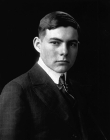
Answer Ernest Miller Hemingway was born on July 21, 1899 in Oak Park, Illinois to Dr. Clarence Edmonds Hemingway and Grace Hall Hemingway. The second of six children, Ernest enjoyed an adventurous boyhood, fishing and hunting with his father in the northern woods of Michigan. He attended Oak Park High School where he excelled in his classes, particularly English. He tried his hand at football and swimming, edited the school paper (the Trapeze), and contributed pieces to the school's literary magazine (the Tabula). After graduating high school, Ernest traveled to Kansas City and worked as a cub reporter for The Kansas City Star. In 1918, he began service as an ambulance driver for the Italian army. On July 8, he was wounded at Fossalta on the Italian Piave while delivering chocolates, cigarettes, and postcards to soldiers.

He married Elizabeth Hadley Richardson on September 3, 1921. The newlyweds soon entered the literary community of Paris, living off of Hadley's trust fund and Ernest's pay as a foreign correspondent for the Toronto Star. The 1920's were extremely productive writing years for Hemingway. Three Stories and Ten Poems was published in 1923, In Our Time in 1925. In 1926, The Torrents of Spring and the widely successful novel, The Sun Also Rises were published. A collection of short stories titled Men Without Women followed in 1927. This year also signified the end of Hemingway's marriage to Hadley and his subsequent marriage to Pauline Pfeiffer on May 10, 1927. Ernest and Pauline would spend the majority of their years together at 907 Whitehead Street in Key West, Florida. On December 6, 1928, Hemingway was dealt a devastating emotional blow as his father, suffering from severe diabetes and concerned about his financial future, shot himself.

Hemingway continued to write producing what many critics still feel is the best novel ever written about World War I. A Farewell to Arms was published in 1929 and solidified Hemingway's reputation as one the greatest writers of his generation. The 1930's would see the publication of Hemingway's bible on bullfighting, Death in the Afternoon (1932), a recount of his African safari in Green Hills of Africa (1935) and two famous short stories, "The Snows of Kilimanjaro" (1936) and "The Short Happy Life of Francis Macomber" (1936).

In the late 1930's, Hemingway ventured to Spain to give his encouragement to the Loyalists fighting in the Spanish Civil War. His experiences as a war correspondent for the North American Newspaper Alliance would inspire his other great war novel, For Whom the Bell Tolls. Exactly one month after the 1940 publication of For Whom the Bell Tolls, Hemingway married fellow writer and war correspondent Martha Ellis Gellhorn. It was a marriage that would last only five years. He married fourth and final wife Mary Welsh Monks on March 14, 1946. For the next fourteen years, the couple would live in Hemingway's Finca Vigía (Lookout Farm) in San Francisco de Paula, Cuba.

After a disappointing reception of his 1950 novel, Across the River and into the Trees, Hemingway rallied producing The Old Man and the Sea (1952), a short work that earned him a 1953 Pulitzer Prize and ultimately the 1954 Nobel Prize for Literature. Physically unnerved from two plane crashes earlier that year, Hemingway was unable to attend the prize ceremonies. He would live another seven years.

On July 2, 1961, in his home in Ketchum, Idaho, Hemingway died of a self-inflicted shotgun wound to the head. His wife Mary found him and relayed word of her husband's death to the world. Ernest Hemingway was two and a half weeks shy of his sixty-second birthday. Three sons and millions of loyal readers would preserve his memory.

Return to Life FAQ  |  View all FAQs

Question Can you recommend any good Hemingway biographies? I've already read Jeffrey Meyers and Carlos Baker. I am hesitating to start Kenneth Lynn's for I've heard he overdoes the Freudian implications.

Answer Kenneth Lynn does straggle off onto the psychoanalytic path, though his biography Hemingway is fascinating nonetheless. It's difficult for me to disparage his Freudianizing temptations due to the fact that I've shared similar perspectives in my own research of Hemingway. His book also has one of the most detailed indexes.

Carlos Baker's biography is a formidable one and probably the most tediously researched, though many have found his portrait of Hemingway to be lacking any genuine warmth for or understanding of this extraordinarily complex man. Makes sense, though, considering Baker never met Hemingway.

Hemingway: A Biography by Jeffrey Meyers is another very respectable work. Meyers includes two interesting appendixes: one charting the numerous accidents and illnesses of Hemingway throughout his lifetime, the other his trips abroad. I call the bios by Lynn, Baker, and Meyers "the big three" and any serious EH scholar or enthusiast should have these works in his or her possession.

Then there is A. E. Hotchner's memoir, Papa Hemingway, which too has received criticism over the years. Some have questioned the accuracy of his representation of Hemingway. Malcolm Cowley put it best when interviewed by Denis Brian: "You know what he did? I could spot it because I knew the sources. When he said 'Hemingway said,' actually he was quoting from Hemingway's letters to him. Because Hemingway's will said: 'You must not quote from my letters. They're protected by copyright.' So Hotchner just put the letters in place of the conversations."

Leicester's Hemingway's, My Brother, Ernest Hemingway offers probably the most complimentary and insightful profile of the famous writer.

If you are looking for literary biographies, Michael Reynolds's multi-volume series is tops.

Return to Life FAQ  |  View all FAQs

Question What were some of Hemingway's nicknames?

Answer Hemingway had many nicknames throughout his lifetime. To his sister Sunny, he was "Oinbones." While in high school, he gave himself the nickname of "Hemingstein." Because of his love of boxing and the great outdoors, he became known as "Champ." His first wife Hadley and son John (by Hadley) affectionately referred to him as either "Ernestoic," "Tatie," "Tiny," or "Wax Puppy." Even the child shared in the fun, acquiring his own nickname of "Bumby." Hemingway was also known in some circles as "Wemedge." More obvious nicknames included "Ernie," "Hem," and "Hemmy." But the most enduring and most recognized nickname for Hemingway would be "Papa."

Return to Life FAQ  |  View all FAQs

Question Was Hemingway an alcoholic?

Answer It has been reported that during the last twenty years of his life, Hemingway got himself into the habit of consuming a quart of whiskey a day. To many, such drinking behavior would indicate alcoholism. Hemingway did like to drink and was blessed with the ability to drink great amounts without showing the effects (don't know if this is a blessing, to some I imagine it is). Towards the end of his life when his health began to deteriorate and his doctors told him to lay off the bottle, he did, but only temporarily. Whenever he felt the urge, he would pick up the practice again. It wasn't the alcohol though that killed Hemingway in the end. It was a shotgun blast to the head. Hemingway was passionate about so many things in his life, alcohol just happened to be one of them. He carried this passion with him wherever he went. Alcohol truly was his moveable feast.

Return to Life FAQ  |  View all FAQs

Question How accident prone was Hemingway?

Answer Hemingway suffered through an enormous amount of accidents and ailments in his lifetime. In his book, Hemingway, Kenneth Lynn gives an inventory list of health problems that consumed Hemingway in his later years. These included: concussion of the brain, ruptured liver, crushed vertebra, temporary hearing and vision loss, and first-degree burns from two planes crashes in 1954. The entire list of health problems can be found on 529 of Lynn's book.

Return to Life FAQ  |  View all FAQs

Question Did Hemingway suffer from depression?

Answer Ernest Hemingway did suffer from depression, particularly in the last years of his life. His depression was so severe, in fact, that he was admitted to the Mayo Clinic in Rochester, Minnesota in December of 1960. There he received a series of electroshock treatments, which some felt did more harm than good.

Return to Life FAQ  |  View all FAQs

Question How much did Hemingway travel in his lifetime?

Answer To say Ernest Hemingway was a worldly traveler in his lifetime is quite the understatement. Before the age of twenty-five, Hemingway had seen Italy, Paris, Spain, Germany, Switzerland, Austria, and Constantinople. In his adult years, he traveled to Africa, Cuba, Hong Kong, Hawaii, and London. Hemingway's favorite destinations in the United States included Key West, Florida, the Nordquist ranch in Wyoming, and Sun Valley, Idaho. Michael Palin's 1999 book, Michael Palin's Hemingway Adventure gives an entertaining account of Hemingway's travels through Palin's eyes, as he sets out to retrace the footsteps of the famous author.

Return to Life FAQ  |  View all FAQs

Hemingway Collectibles

Rare books, autographs, and more
View Hemingway Collectibles
Hemingway Books
The Complete Works of Ernest Hemingway

The complete works
Discover Hemingway Books
Ernest Hemingway Primer
The Ernest Hemingway Primer

Download your free copy of
The Ernest Hemingway Primer
Hemingway First Editions

Judge a book by its cover
Learn to Identify First Editions
Hemingway Photos
Hemingway Photos

A life in pictures
View Hemingway Photos
The Mobile Hemingway
Timeless Hemingway Mobile

Bio, FAQs, and quotes on the go at
Timeless Hemingway Mobile